



A–Z of Stud Welding: The Complete Guide from Taylor Studwelding

Stud welding is one of the fastest, strongest and most efficient ways to fix components to metal. Whether you’re working in automotive, shipbuilding, construction, HVAC, signage, insulation or precision fabrication, stud welding offers accuracy, speed and a reliable one-side fastening solution.
This expanded A–Z guide gives you a detailed breakdown of the processes, terminology, equipment and advantages - helping manufacturers, engineers and designers understand where stud welding fits into modern production. We also have a handy, visual A-Z guide available as a download here.

Applications, Accuracy, Accessories & Automation
Applications
Stud welding is used across an exceptionally wide range of industries, including:
Shipbuilding (bulkheads, decking, insulation pins)
Construction & structural steelwork
Electrical enclosures and switchgear
Signage and architectural displays
Automotive manufacturing (body panels, brackets, insulation)
HVAC units, ducting and cladding
Furniture and point-of-sale displays
White goods and electronics
Because the process requires access from just one side, it enables fast, clean fastening where drilling or riveting is slow, impossible or inferior. Find out more about stud welding applications here.
Accuracy
Automated CNC stud placement delivers pinpoint accuracy and consistent weld quality - ideal for high-volume production. Taylor Studwelding’s computer numerical control systems produce an accuracy rate better than +/- 0.15mm, an incredibly narrow range.
Accessories
Taylor Studwelding not only manufactures and supplies equipment, but also stocks over 10+ million components too. From chucks and cable plugs to hand tools and weld studs, we have everything you need for your specific stud welding project. If you are unsure of the exact requirements for your application, just get in touch and we’ll be happy to advise you.
Automation
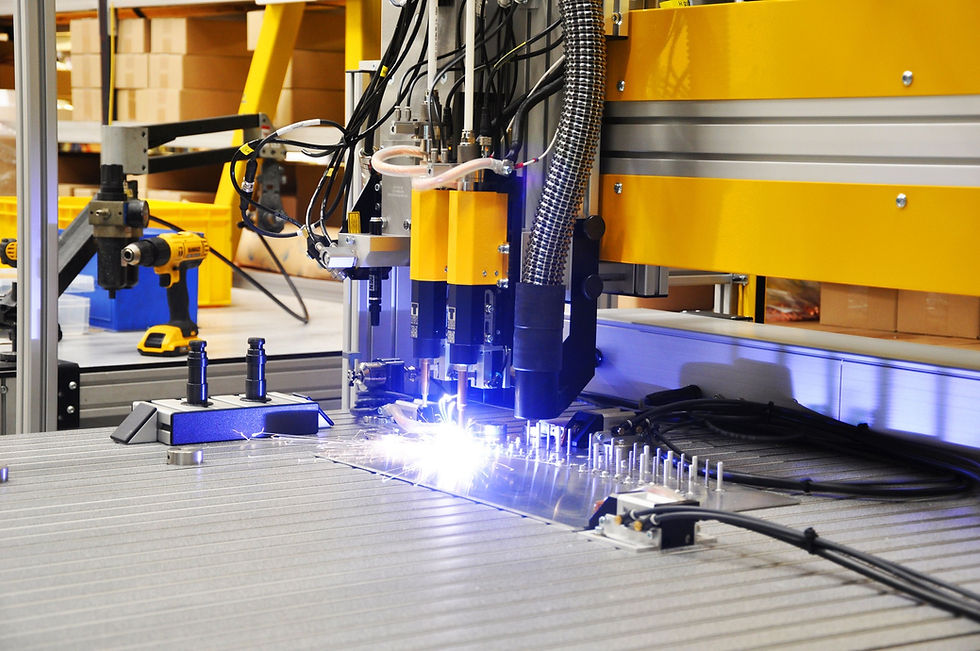
Taylor Studwelding provides equipment for seamless integration with CNC and robotic systems (up to 5 axes) for large-scale, repeatable fastening. This approach allows for ultimate precision at scale.

Benefits, Bridge Building & Best Process
Benefits
Stud welding offers:
No drilling, punching, thread cutting, bonding, riveting or tapping required
No reverse marking
Suitable for painted, enamelled, electro-plated or plastic coated surfaces
Liquid tight and gas tight welds with the coating undisturbed
Fast, clean, reliable and strong attachment
Bridge Building & Heavy Steelwork
Drawn Arc stud welding is widely used in heavy fabrication. Taylor Studwelding’s latest Drawn Arc stud welder, the DA i22, has been specifically designed for heavy-duty applications such as bridge building, machinery frames and ship hulls. Strong penetrative welds are essential for these applications.
Brackets & Fixings
Studs are ideal for mounting brackets, supports and fittings without piercing the far side of the material.
Best Process
There are various processes that you can choose from when carrying out stud welding. The best process will be dependent upon the nature of your project. Our expert team to guide you through the processes including, Capacitor Discharge, Drawn Arc and Short Cycle stud welding, advising you on the most suitable process for your requirements.

Capacitor Discharge, CNC, Coated Materials & Cladding
Capacitor Discharge (CD) Stud Welding
Perfect for thin-gauge material, signage, cabinets, appliances, electronics and aluminium fabrications. Taylor Studwelding offers a complete range of capacitor discharge controllers and accessories.
CNC
Taylor’s CNC (computer numerical control) equipment can be designed to meet specific turn key production requirements. Anything up to 5-axis is available.
Coated Materials
Coated Materials can prove troublesome for any welding processes, but Capacitor Discharge systems can weld to electroplated surfaces such as zintec, where the coating is thin enough to be burnt off during welding. Thicker coatings, galvanising or paints require grinding back to bare metal to get successful welds.
Cladding & Building Envelopes
Weld studs attach façade panels, cladding brackets and insulation without visible fixings. Stud welding is a popular process for this type of fastening.

Drawn Arc, Durability, Decking & Design Improvements
Drawn Arc (DA) Stud Welding
Drawn Arc stud welding is used for fastening larger studs (up to 30mm diameter) and heavy-duty structural applications. At Taylor Studwelding we provide a full range of drawn arc controllers, hand tools and accessories. Get in touch with our team for advice on the most suitable equipment for your needs.
Durability
Stud welds are liquid-tight, gas-tight and vibration-resistant - ideal for marine and industrial environments. Stud welding is well-known for its strong, long-lasting bond.
Decking (Construction & Shipbuilding)
Drawn Arc studs secure shear connectors, decking sheets and stiffeners across construction and marine engineering.
Design Improvements
Stud welding allows a single-side fastening with no reverse markings on the parent material. This improves design aesthetics as connections can be made without penetrating through the material.

Equipment, Efficiency & Enclosures
Equipment Range
Our equipment ranges from small handheld units through to fully automated CNC systems designed to meet specific production requirements. We manufacture all our equipment in the UK, adhering to high quality standards and we can supply everything from the controllers to the weld studs. Taylor Studwelding is your one-stop-shop for everything stud welding related!
Efficiency
Stud welding drastically reduces fabrication time when compared with other methods of fastening - especially drilling, tapping or bolting. Taylor Studwelding machines are also well known for their ease of use, speeding up operations.
Electrical Enclosures
Stud welding is frequently used for mounting internal components within electrical enclosures without breaching the enclosure wall.

Fastening, Ferrules & Fabrication
Fastening Speed
One of the standout advantages of stud welding is its exceptional fastening speed - far surpassing traditional fastening methods such as bolting or riveting.
Capacitor Discharge (CD) stud welding completes a weld in just 1–3 milliseconds, making it ideal for high-volume production lines. Drawn Arc (DA) stud welding, used for larger-diameter studs and structural applications, still completes in only 1–3 seconds, delivering high-strength welds at a fraction of the time required for mechanical fixings.
Ferrules
Ferrules play a crucial role in the Drawn Arc (DA) stud welding process. These small ceramic rings are positioned around the weld area before the stud is fired. They serve several essential functions that ensure a clean, controlled and structurally sound weld by containing and shaping the molten pool.
Fabrication Use Cases
Stud welding is a versatile solution across many fabrication environments, offering fast, reliable attachment without drilling or access to the reverse side of the material. Some of the most common use cases include:
Metal cabinets - e.g. industrial control boxes, electrical enclosures
Furniture frames - e.g. metal office furniture, shelving systems
Automotive assemblies - e.g. securing panels, trim components
Agricultural machinery - e.g. mounting guards, hydraulic line supports

Gauge, Grip Strength & Global Reach
Gauge
One of the major advantages of stud welding - particularly Capacitor Discharge (CD) welding - is its ability to work effectively on thin-gauge materials without causing distortion, burn-through or reverse marking. This makes it a preferred fastening method across industries that rely on lightweight or delicate sheet metal.
Grip Strength
Stud welds offer exceptional grip strength because the bond is metallurgical rather than mechanical. This results in joints that are often stronger than the stud or parent material itself, making stud welding ideal for load-bearing components and high-vibration environments.
Global Network
Taylor Studwelding supports customers worldwide with international agents and subsidiaries throughout the globe.

Hire, Heat Resistance & HVAC
Hire Services
Hiring stud welding equipment is a flexible, budget-friendly option for businesses handling short-term projects, seasonal workloads or one-off production runs. It’s also ideal for companies wanting to trial specific machines before committing to a full purchase. Taylor Studwelding’s UK hire service ensures you get reliable, well-maintained equipment, allowing you to complete jobs efficiently without long-term investment. If cost is an issue or if you only have a small job to complete, why not “try before you buy” and hire a Taylor Studwelding machine now!
Heat Resistance
One of the biggest advantages of stud welding is its extremely low heat signature. The weld is completed in milliseconds, meaning the surrounding material absorbs very little thermal energy. This helps prevent distortion, warping, discolouration and damage, making stud welding ideal for thin sheet metal and temperature-sensitive materials. Even in Drawn Arc applications where heat input is slightly higher than capacitor discharge, the process remains controlled and localised, protecting the integrity of the parent material.
HVAC Industry
Stud welding is widely used in the HVAC sector thanks to its speed, cleanliness and ability to create secure fixings on thin metal ducting and panels. Common applications include insulation pins, mounting brackets, support studs, access panel fixings and equipment fastening points. Because access is required from only one side, installers can quickly attach components to ductwork or casings without drilling through the sheet, maintaining the duct’s airtight integrity. This makes stud welding a go-to solution for manufacturers and contractors working with ventilation systems, air handling units and climate control equipment.

Insulation, Invisible Fixing, Innovation & Industrial Machinery
Insulation Fixings
Stud welding is one of the most efficient and reliable ways to install thermal, acoustic and fire-resistant insulation across a wide range of industries. In construction and shipbuilding, insulation pins can be welded directly onto steel bulkheads, decks, internal walls or ducting in just milliseconds. This is far faster than adhesives or mechanical fasteners.
Invisible Fixing
One of the most attractive benefits of stud welding, especially for architectural and cosmetic applications, is its ability to create completely hidden fastenings. Since the stud is welded from the rear side of the panel, there are no visible screws, rivets or bolts on the front face.
Innovation
Innovation is at the heart of Taylor Studwelding, driving new possibilities for product design, manufacturing efficiency and engineering performance. Many of Taylor Studwelding’s equipment enhancements, tooling options and automated systems have been created not just through internal R&D, but by understanding the real challenges manufacturers face on the shop floor. We listen to our customers and encourage feedback to help us design new, modern machinery which not only utilises the latest technology, but also solves real-life problems.
Industrial Machinery
Studs are commonly used to mount safety guards, protective covers, brackets, switches, sensors, cable routing fixtures, electrical housings and control panels without drilling through the equipment body. Because stud welds form a metallurgical bond, they resist vibration, impact and long-term wear - making them ideal for harsh environments.

Joining, Jigs & Job Shops
Joining
A fast method of attaching components, especially in automated multi-head systems.
Jigs & Positioning Tools
Used to ensure repeatable placement for batch production.
Job Shops & Custom Fabricators
Small workshops benefit from CD machines for versatile, cost efficient fastening.

Knowledge, Kits & Keyhole-Free Fastening
Knowledge
Taylor Studwelding’s expertise spans over 40+ years, guiding customers through process selection and equipment choice. Our friendly team is always happy to help with any questions you may have.
Kits
To help our customers easily identify which controllers match with which accessories and hand tools, we’ve compiled a list of best-selling stud welding kits. If you have any doubt about which bundle is right for you, don’t hesitate to get in touch.
Keyhole-Free Fastening
No pre-drilled holes means no leaks, no corrosion paths and no weakening of material.

Labour Savings, Lightweight Materials & Logistics
Labour Savings
Reduction in labour is a direct cost saving from using stud welding in your manufacturing process. Less drilling, grinding, deburring and assembly time.
Reduction in labour time = COST SAVINGS.
Lightweight Material Compatibility
Stud welding is highly compatible with thin-gauge, lightweight materials. Capacitor Discharge welding is an ideal process for attachments to thin aluminium in aerospace, automotive and EV components.
Logistics Reliability
We keep over 10+ million studs and accessories in stock for rapid dispatch. Our popular controllers are also stocked ready to ship, whilst our made-to-order, bespoke automated machinery is built quickly and efficiently. So, no matter what you need from us, you can be sure that delivery times are kept to an absolute minimum.

Materials, Marine Industries, Manufacturing Lines& Made in the UK
Materials
Stud welding is compatible with a wide range of materials, making it suitable for everything from lightweight aluminium panels to heavy-duty structural steel. Taylor Studwelding supplies studs in stainless steel, mild steel, aluminium and brass, allowing manufacturers to match the stud material to the parent metal for optimal weld integrity.
Marine & Shipbuilding
Stud welding is a core fastening method in marine engineering and shipbuilding, where strength, productivity and corrosion resistance are essential. It is used extensively on bulkheads, decks, hull structures, accommodation areas and engine rooms for attaching insulation pins, electrical cable supports, pipe brackets, outfitting components and reinforcement elements. The process is fast, reliable and resistant to the demanding conditions of marine environments - vibration, moisture, saltwater exposure and fluctuating temperatures.
Manufacturing Lines
Stud welding integrates easily into automated production environments, making it a powerful tool for high-volume manufacturing lines. Whether paired with robotic arms, CNC positioning systems, conveyors, jigs or multi-head welding stations, it delivers exceptional speed, consistency and repeatability.
Made in the UK
All of our stud welding equipment is made in our Yorkshire factory in the United Kingdom.

No Nonsense Ordering, No Reverse Marking & Noise Reduction
No Nonsense Ordering
Taylor Studwelding delivers exactly what customers order - quickly and reliably.
No Reverse Marking
A key advantage for decorative panels, signage and architectural work.
Noise Reduction
Eliminates drilling noise in the workshop.

One-Side Access, Offshore Use, Online Demos & Officially Leading the UK
One-Side Access
One of the defining advantages of stud welding is that all work is carried out from a single side of the material. There’s no drilling, tapping or access behind the sheet required. This avoids compromising the strength, sealing or cosmetics of the reverse surface.
Offshore Industries
Harsh offshore conditions demand fast, durable and corrosion-resistant fastening methods. Stud welding is used extensively on ships, oil platforms, wind turbines and marine structures because it can withstand corrosion and vibration in offshore structures.
Online Demos
Taylor Studwelding understands that investing in new equipment is a big decision - which is why we offer online demonstrations to help customers explore the right solution without needing to travel or interrupt production schedules. Online demos make it easy to evaluate machine capabilities, weld quality and performance from anywhere in the world. They’re perfect for multi-site teams, early-stage project planning, or customers needing quick guidance before placing an order or arranging a physical trial.
Officially Leading the UK Market
Taylor Studwelding is the UK’s only designer and manufacturer of Studwelding equipment. The team is constantly innovating to design, test and launch new products to the worldwide market.

Productivity, Panel Work & Profitability
Productivity
One of the biggest strengths of stud welding is how quickly and efficiently it enables you to assemble components. With modern stud-welding machines - particularly automated or CNC-equipped ones - welds can be completed at remarkable speed, dramatically increasing throughput.
Panel Work
Stud welding is used heavily in signage, electrical cabinets, vehicles and appliances.
Profitability
Investing in a modern stud welding system is not just about better welds - it’s also a smart business decision that delivers real, measurable financial returns over time. There are several factors that drive profitability, including, reduced labour costs, less waste, less rework, high output and low operating costs.

Quality, Quick Attachment & Quantity Production
Quality
The quality of the stud - and the weld it produces - is critical to long-term performance. Taylor Studwelding manufactures studs to the highest standards, ensuring consistent welds, thread accuracy and weldability.
A correctly welded stud forms a strong bond with the parent material, resulting in exceptional strength and reliability - often stronger than the stud or panel itself. With precision controls for lift, current and timing, modern machines ensure repeatable results and minimal rework across every shift.
Quick Attachment
Stud welding offers incredibly fast attachment - whether applied using a hand tool or through automation. A typical weld takes milliseconds for Capacitor Discharge or just seconds for the Drawn Arc process, making the process quicker than drilling and tapping or traditional mechanical fasteners. This drastically shortens assembly times, cuts labour requirements and accelerates production, particularly for repetitive fastening tasks.
Quantity Production
Stud welding thrives in high-volume environments. With minimal setup time and rapid cycling, it enables hundreds or thousands of welds per shift - especially when integrated into CNC, multi-gun or robotic systems. These setups deliver accurate and consistent stud placement, supporting lean manufacturing and strong output efficiency. This makes stud welding one of the most scalable fastening solutions available.

Reliability & Robotics
Reliability
Stud welding is one of the most reliable fastening methods available. It creates a strong bond between the stud and parent material and the connection is often stronger than the materials themselves. This makes it ideal for environments where vibration, heavy loads and long-term durability are critical.
Robotics
Our stud welding equipment can be easily integrated with robotic systems, unlocking maximum speed, precision and consistency for high-volume manufacturing lines. Robotic automation also enhances workplace safety by reducing manual handling and operator fatigue in processes where repeatability is excessive. Manufacturers can run extended shifts with minimal downtime, resulting in greater throughput, improved weld consistency and greater ROI.

Short Cycle, Signage, Shipbuilding & Structural Steel
Short Cycle Welding
The short cycle (SC) process is the same as for Drawn Arc “DA” but operates over a much shorter time period - up to 100 milliseconds. Ceramic arc shields (ferrules) are not required with this process but shrouding with gas can improve weld fillet formation especially when welding stainless steel studs. Capacitor Discharge studs may also be used with short cycle welding.
Signage
Stud welding is widely used in the signage and architectural branding sector because it provides invisible rear-mounted fixing. With access needed from only one side, studs are welded to the rear of metal letters, trays, fascia panels and display boards — leaving the front perfectly smooth and visually flawless. CD welding is typically used due to its minimal heat input and zero reverse marking. Threaded studs allow fast installation on-site, keeping signage secure and aesthetically pleasing.
Shipbuilding
Stud welding is a core fastening method in ship and offshore construction thanks to its speed, strength and harsh conditions resistance. It is typically used for attaching:
Insulation pins in accommodation and engine rooms
Electrical cable management systems
Pipe, bracket and equipment supports
Interior fit-out and outfitting components
Structural stiffeners and reinforcement points
Because it requires access from only one side, installers can work quickly in tight compartments and behind lining materials. Drawn Arc studs provide high-strength performance in heavy steel, while stainless studs offer corrosion resistance in harsh marine environments.
Structural Steel
For construction and civil engineering, Drawn Arc stud welding is the standard for securing studs. Drawn Arc studs provide high-strength fixings for steel decking, load-bearing brackets and structural reinforcements.

Turnkey Systems, Training & Thin Materials
Turnkey Systems
We can design and manufacture a turnkey system to meet your specific production requirements. We understand that every production environment is different, which is why Taylor Studwelding provides fully bespoke systems, designed around each customer’s workflow, space and output requirements.
Training
Skilled operators deliver the best welds and Taylor Studwelding ensures that your teams are fully equipped for success. Training can take place either on-site at the customer’s facility or at Taylor HQ. We also provide a wealth of supporting documentation as well as video set up guides in our resources section of the website. Furthermore, you can also request an online demo.
Thin Materials
One of the biggest advantages of stud welding, particularly Capacitor Discharge (CD), is its ability to work reliably on thin-gauge materials without distortion or marking. Even at 0.7mm thickness and above, the short weld duration protects the base metal and maintains its strength and finish.

UK Manufacturer, Ultra-Fast Welds & Universal Compatibility
UK Manufacturer
Proudly designed and built in Britain. Taylor Studwelding is the UK’s only designer and manufacturer supplying the international market with compact handheld units, fully automated systems and associated accessories.
Ultra-Fast Welds
Stud welding is one of the fastest fastening methods in the world. This speed removes bottlenecks in assembly and ensures that even high-volume production lines can keep moving without interruption. Faster welding = more output per shift, fewer labour hours per job, and a dramatic reduction in overall cost-per-fix.
Universal Compatibility
Stud welding is used across almost every sector, from fine-finish architectural work to heavy industry. Studs and equipment are compatible with a wide range of materials (mild steel, stainless, aluminium, brass) and product types, ensuring a solution for any fastening challenge.

Value Added, Versatility & Ventilation Systems
Value Added
Stud welding adds value at every stage of the manufacturing process. By eliminating drilling, tapping and secondary finishing, overall assembly time is drastically reduced - meaning lower costs per unit and faster turnaround for customers.
Versatility
Few fastening processes are as versatile as stud welding. It supports multiple welding processes - Capacitor Discharge (CD), Drawn Arc (DA) and Short Cycle (SC) - as well as a wide choice of stud materials including stainless steel, mild steel, aluminium and brass. Whether the priority is strength, speed, lightweight design or cosmetic excellence - stud welding adapts effortlessly.
Ventilation Systems
Stud welding plays a key role in HVAC and ventilation manufacturing, delivering fast, secure fixing solutions on ducting and panels. Studs are used to attach insulation, brackets, panels and internal partitions. With access from only one side, stud welding preserves the airtight integrity of ducts and housings.

Welding Simplicity, Warehousing & Weather Resistance
Welding Simplicity
Simple to operate, consistent to use, and easy to automate.
Warehousing & Storage
Studs stored in bulk for fast, reliable supply chains.
Weather Resistance
Stud welding produces secure, sealed fastening for outdoor environments.

eXperts, X-Y CNC Control & eXpanded Capabilities
eXperts
Taylor Studwelding’s greatest strength is its people — a team with decades of combined stud welding experience who understand not just the technology but the real-world challenges manufacturers face. From process selection to custom tooling, automation integration and on-site optimisation, their specialists work closely with customers to ensure the right solution is designed for the job - not simply a product fitted into a process.
X-Y CNC Control
Modern stud welding achieves exceptional positioning accuracy thanks to multi-axis CNC systems. Taylor Studwelding manufactures advanced automated machines with multi-axis control that allows precise stud placement for complex components.
eXpanded Capabilities
Stud welding continues to evolve and Taylor Studwelding pushes the boundaries. Whether it’s enhancing production throughput, reducing manual handling, or engineering a brand-new solution from scratch, Taylor Studwelding provides the expertise and technology to take stud welding further.

Yellow Livery, Yield Improvements & Year-Round Support
Yellow Livery
Taylor Studwelding machines are instantly recognisable thanks to their distinctive yellow finish - a symbol of British engineering heritage and industrial strength. The bold colour not only reinforces brand identity on factory floors across the UK and worldwide but also helps equipment stand out clearly in busy production environments, supporting safe and efficient operation. This visual signature reflects what Taylor equipment is known for: durability, quality and long-term performance.
Yield Improvements
Stud welding contributes directly to higher production yields by reducing rework, scrap and assembly time. With consistent weld quality and a clean, one-step fastening process, parts leave production lines right-first-time far more often than with mechanical fixings or drilling-intensive methods.
Year-Round Support
Taylor Studwelding provides ongoing service and technical assistance to ensure every customer maximises the value of their equipment - not just on installation day, but throughout the lifetime of the machine. With UK-based engineers, international distributors and agents and a large stock of parts and studs always available, customers can rely on responsive support 12 months a year, keeping production lines running smoothly and efficiently.

Zoom in on Speed, Zero Reverse Marking & Zero Hassle Ordering
Zoom in on Speed
When it comes to speed, stud welding stands in a league of its own. The process delivers incredibly rapid fastening. It’s not only the process that is fast! We’ll provide quick quotes and short delivery lead times.
Speed doesn’t just improve productivity - it increases competitiveness.
Zero Reverse Marking
One of the standout advantages of stud welding is the ability to fix studs securely without leaving any marking or distortion on the opposite side of the material, especially with CD stud welding. Surfaces remain perfectly smooth, maintaining strength and aesthetic quality and with no need for patches or finishing work.
Zero Hassle Ordering
Taylor Studwelding prides itself on offering a simple, reliable and responsive ordering experience. Whether a customer needs a single machine, custom tooling, or bulk quantities of studs, ordering is fast and straightforward - backed by large UK stock for rapid dispatch.
Ready to Improve Your Production?
Whether you need handheld CD systems, Drawn Arc solutions, CNC automation or integration into a complete turnkey production line, Taylor Studwelding delivers the expertise, equipment and reliability required for modern manufacturing.
Contact Taylor Studwelding Systems Ltd


Comments